Vehicle-to-Grid Technology: How Your EV Could Power the Grid of Tomorrow
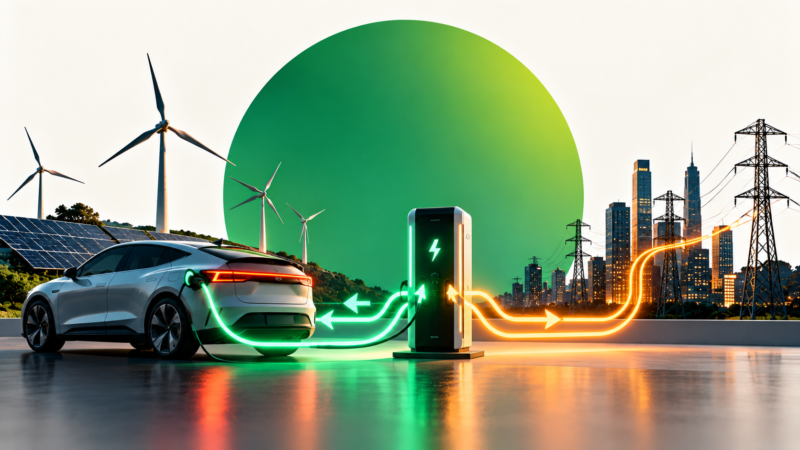
Electric vehicles are usually thought of purely as consumers of electricity — plug in, charge up, drive away. But a quietly growing innovation called vehicle-to-grid technology is flipping that assumption on its head, turning millions of parked EV batteries into a distributed energy resource capable of sending power back to the grid when it’s needed most.
As grids worldwide grapple with the challenge of integrating more renewable energy, the vehicle-to-grid benefits of turning idle EV batteries into flexible storage assets are becoming impossible to ignore. Utilities, automakers, and policymakers are all exploring how this emerging two-way relationship between cars and the electricity network could reshape power markets over the next decade
How Bidirectional EV Charging Works
At the heart of vehicle-to-grid technology lies a capability called bidirectional EV charging, which allows electricity to flow in both directions through the same charging setup — from the grid into the car, and from the car back out into the grid or home. Conventional EV chargers are one-directional, meaning power only ever moves one way: into the battery.
Bidirectional EV charging requires specialized hardware on both the vehicle and the charging unit, including an inverter capable of converting the battery’s stored DC power back into grid-compatible AC electricity. Several automakers have already begun equipping select EV models with this capability, while charging equipment manufacturers race to bring compatible, affordable hardware to market. Without it, a parked EV remains just a battery on wheels — incapable of participating in a true vehicle-to-grid technology ecosystem
Understanding V2G Charging Technology
V2G charging technology encompasses far more than just physical hardware — it also includes the software, communication protocols, and grid-management systems needed to coordinate thousands, or even millions, of individual vehicles acting as tiny power plants. Standards bodies around the world are still working to harmonize these protocols so that V2G charging technology deployed by one automaker can interact seamlessly with charging infrastructure built by another.
Pilot programs testing this technology are already underway in markets like the UK, the Netherlands, Japan, and parts of the United States, where utilities pay EV owners for the flexibility their parked vehicles provide. These early trials are helping refine both the technical standards and the financial incentive structures needed before this category of charging can scale meaningfully beyond small pilot fleets.
Ready to switch to Solar?
Solar solutions with Anya Green Energy and discover how you can reduce your electricity bills.
Contact UsEV Battery Grid Integration: The Bigger Picture
Zooming out, EV battery grid integration represents a much larger shift in how electricity grids are designed and operated. Traditionally, grids were built around large, centralized power plants sending electricity in one direction to homes and businesses. EV battery grid integration introduces millions of small, mobile, distributed storage units into that equation — each capable of charging during low-demand hours and discharging during peaks.
As one grid-modernization expert put it in a recent industry panel, “every parked EV is a battery the grid already paid to build — the only question is whether we’re smart enough to use it.” This idea captures why EV battery grid integration is drawing so much attention from utilities facing rising peak demand and renewable intermittency challenges. Done well, this kind of integration could reduce the need for expensive new peaker plants and large-scale stationary battery installations.
Vehicle-to-Grid Benefits for Consumers and the Grid
The vehicle-to-grid benefits extend to multiple stakeholders at once. For individual EV owners, participating in a vehicle-to-grid technology program can mean earning money or bill credits simply by allowing their parked car’s battery to support the grid during peak hours. For utilities, the vehicle-to-grid benefits include a flexible, fast-responding resource that can help balance supply and demand without building entirely new infrastructure.
- Grid stability — distributed EV batteries can respond to demand spikes faster than most traditional power plants.
- Reduced need for peaker plants — utilities may rely less on expensive, polluting backup generation during peak hours.
- Additional income for EV owners — participation can offset charging costs or generate direct payments.
- Better renewable energy utilization — vehicle-to-grid technology helps store excess solar or wind generation for later use.
- Emergency backup power — some systems allow EVs to power homes directly during outages.
- Accelerated EV adoption — the vehicle-to-grid benefits of turning an EV purchase into a potential income-generating asset could make electric vehicles more financially attractive overall.
Quick Comparison: Conventional Charging vs Vehicle-to-Grid Charging
| Factor | Conventional (One-Way) Charging | Vehicle-to-Grid Charging |
|---|---|---|
| Power flow | Grid to vehicle only | Grid to vehicle and vehicle to grid |
| Hardware required | Standard charger | Bidirectional charger + compatible inverter |
| Value to grid | None beyond demand | Can supply power during peak demand |
| Owner incentive | None | Potential payments/bill credits |
| Current maturity | Widely available | Early pilot stage in most markets |
Global and India Landscape
Globally, pilots have multiplied over the past few years, with Japan’s early CHAdeMO-based V2G charging technology trials often cited as some of the first commercially meaningful deployments. The UK’s various demonstration projects have similarly tested how EV battery grid integration could work within a liberalized electricity market.
Data disclosure: Project names, pilot locations, and timelines referenced here are illustrative, based on general industry knowledge rather than live data retrieval in this session. Figures and program details should be verified against current IEA, IRENA, or national grid operator sources before publishing.
In India, vehicle-to-grid technology remains almost entirely at the conceptual and pilot-study stage. The country’s EV charging infrastructure is still primarily focused on conventional one-directional charging, and the regulatory frameworks needed to support two-way power flow remain largely absent from the market today. Still, as India’s EV adoption accelerates and rooftop solar penetration grows, interest in using EV batteries as a long-term grid-balancing tool is likely to increase.
Challenges Standing in the Way
Despite the promise, several real barriers stand between today’s pilots and widespread vehicle-to-grid technology adoption. Battery degradation remains a key concern — automakers worry that the frequent charging and discharging cycles required for bidirectional EV charging could shorten battery lifespan, even though recent studies suggest well-managed cycling may have a smaller impact than once feared.
Regulatory and market design hurdles are equally significant. Many electricity markets still lack the frameworks needed to fairly compensate EV owners for the vehicle-to-grid benefits they provide, and utility interconnection rules in many regions were never designed with millions of small, mobile power sources in mind. Until standards mature and markets evolve to reward this flexibility, large-scale adoption will likely remain limited to pilot programs and early-adopter markets.
Future Outlook
Looking ahead, most analysts expect vehicle-to-grid technology to follow a gradual, utility-by-utility rollout rather than a single dramatic global launch. As EV fleets grow larger and battery costs continue falling, the business case for V2G charging technology should strengthen considerably, particularly in markets with volatile electricity prices and high renewable penetration.
For bidirectional EV charging to become a mainstream feature rather than a niche pilot capability, automakers, charging hardware makers, and grid operators will need to align on common standards over the next several years. Realizing this technology’s full potential will depend heavily on regulatory reform that properly compensates EV owners for the flexibility they provide
Where Anya Green Energy Stands on EV-Grid Integration
At Anya Green Energy, our current focus remains on proven, bankable solar generation and storage solutions for homes and businesses. vehicle-to-grid technology is not yet part of our direct product offering, but as India’s EV and solar ecosystems increasingly overlap, we see this as a natural long-term extension of distributed energy — one where rooftop solar, home battery storage, and EV batteries could eventually work together as a single, intelligent energy system.
We’re watching the evolution of vehicle-to-grid technology closely, particularly as it relates to combining rooftop solar generation with EV charging and future bidirectional capability for our customers.
Frequently Asked Questions
Q1: What exactly is vehicle-to-grid technology?
A1: Vehicle-to-grid technology, often abbreviated as V2G, allows electric vehicles to both draw power from and send power back to the electricity grid, turning parked EV batteries into a flexible, distributed energy resource rather than a one-way consumer of electricity.
Q2: Do I need special hardware to participate?
A2: Yes. Standard EV chargers only move power in one direction. Participating requires a bidirectional charger and a compatible vehicle inverter capable of converting stored battery power back into grid-usable electricity.
Q3: Is this technology available in India right now?
A3: Not commercially. India’s EV charging ecosystem is still built primarily around conventional one-directional charging, and the regulatory and hardware pieces needed for two-way power flow are still in early development.
Q4: Will frequent use damage my EV’s battery?
A4: This is a genuine concern automakers are studying closely. Early research suggests that well-managed charging and discharging cycles have a smaller impact on battery lifespan than initially feared, but this remains an active area of research as hardware and software controls improve.
Q5: Will Anya Green Energy offer this technology in the future?
A5: Our current focus remains on rooftop and commercial solar solutions. We continue to monitor developments in EV-grid integration closely, given its natural long-term fit alongside rooftop solar and home battery storage.

Trusted by 50000+ Customers
Anya Green Energy is a leading solar company and Solar Energy service provider established in 2013. We are recognized by startup India and customer best choice award 2022.
Our Achievements :
Recognized by Startup India.
Purvanchal’s first solar company to operate exclusively with solar products.
Certified by well-known institutions such as MSME, IndiaMart, and Just Dial and many more.
Winner of the Best Customer Choice Award 2022.
Over 50,000 happy customers across India.